CripWisdoms: a coloring book for blind and sighted people
A delightful new book shares disability wisdom while introducing readers to disabled leaders like Dr. Sami Schalk, Alice Wong, Miso Kwak, and Emily Nott. You can order a copy in print or in Braille.
Jump to heading#Descriptive Transcript
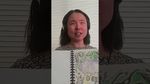
Haben Girma, a woman with long black hair, dancing hazel eyes, and medium dark skin, sits at a picnic table in a park. A large, spiral-bound book in front of her has a row of six illustrated spoons against a peach-colored background. From left to right: a plain spoon, a spoon with an ornate handle, a small spoon, a large spoon with a flourish in the middle, a spoon turned on its side, and a spoon with a square handle. Dotted lines and scissors suggest cutting the spoons out of the page.
Haben: Can blind people color?
She holds up a crayon nestled in a four-sided sleeve.
Haben: In Braille on the crayon it says red.
She rotates the crayon to reveal the other side.
Haben: And then if you flip it, for those who can't read Braille, there's raised print.
She places the crayon down and turns the book around so it faces her instead of the camera.
Haben: The title says, “Crip Wisdoms: A Feminist Disability Studies Coloring Book. Braille version by Emily Nott and Miso Kwak."
She opens the book. The left page is filled with Braille text, and the right page has a tactile drawing.
Haben: Inside are tactile raised images. So this is actually an interactive coloring book. If you want to color, you can color. If you want to do other activities—write poems, have conversations. There's a lot of wisdom in these stories, and it gives people the opportunity to learn about disability culture, disabled leaders while engaging in the way you want to engage.
The video cuts to Miso Kwak, an Asian femme with shoulder length black hair, sitting in front of a window with closed blinds. She wears headphones and holds up her book.
Miso: One of my favorite pages in the book features Dr. Sami Schalk who talked about pleasure activism.
She points to the left page of the book which has Braille text.
Miso: On one side of the book is a Braille text that describes the image of the page. And then on the other side is a tactile version of my co-author Emily's work, artwork.
She indicates a page with a large cloud surrounded by a sandwich and slice of bacon dancing to music notes, cat-eye glasses, a sneaker, a kayak, a mug of tea, a black cat, kissy lips, lipstick, a birthday cake with candles, a sun smiling down at a cloud, a bejeweled candle, books, a weeping box of tissues, a potted plant, a unicorn dancing to music notes, and a sea of hearts.
Miso: So here I've engaged in my own version of pleasure activism, and interacting with this book by coloring in the tactile image. So it has different colors like purple, yellow, and green, and red. And engaging in coloring and other things that really make me feel relaxed and joyful is one way that I try to remind myself to embody pleasure activism in my life. Working on this book has really made me reflect on what it means to sustain myself and share the wisdoms of many disabled activists and scholars that we have featured here. And share that with as many people as possible. So go ahead and follow me, and you can find a link on my bio to order your own copy.
Haben: 100% of royalties will be donated to the Alice Wong Memorial Fund, and Alice Wong is included in this book.
The camera moves closer. Haben’s fingers glide across raised dots on a page. The page next to it shows lines emanating from a bubble. Beside the picnic table, a black and brown Seeing Eye dog listens attentively.
Haben: I'm gonna read a quote from Alice. “The reality of disability and joy means accepting that not every day is good, but every day has openings for small pockets of joy."