Turning Paintings into 3D Art Blind People Can Touch
Iconic paintings and photographs become touchable sculptures through the work of artist Gabrielle Sauvillers. Blind people should have access to art, no matter how complex or controversial. We met in France during the Braille Bicentennial, and she created the dioramas featured in this video.
Tactile art helps me learn about the visual world more effectively than written descriptions. Let’s create a world where 3D models of visual art are available to everyone who learns through their sense of touch.
Jump to heading#Descriptive Transcript
Haben: Would you rather get a description of a painting or would you rather place your hands inside a 3D painting?
Image: The famous painting called "The Great Wave of Kanagawa” shows an ocean wave towering over three wooden boats full of rowers bracing for impact. The wave curls forward like a claw with sharp, white foam at its tips. The water is deep blue with lighter streaks that convey movement. In the distance, snow-capped Mount Fuji appears tiny and calm compared to the threatening wave in the foreground.
Photo: A large diorama display box provides a sculptural interpretation of the painting. Smooth satin stretches around a hidden frame to form the shape of waves, and white lace trim along one edge represents the crests. There are four waves, with the largest in the back. Between the first two sits a wooden boat with stick figures.
The boat and waves can be moved out of the box, helping people understand how the different elements of the painting come together. At the very back of the box, appearing small compared to the waves, is Mount Fuji in raised, textured paint. The back wall also has raised Japanese characters.
The video cuts to Haben sitting inside a large tent with tables featuring art pieces.
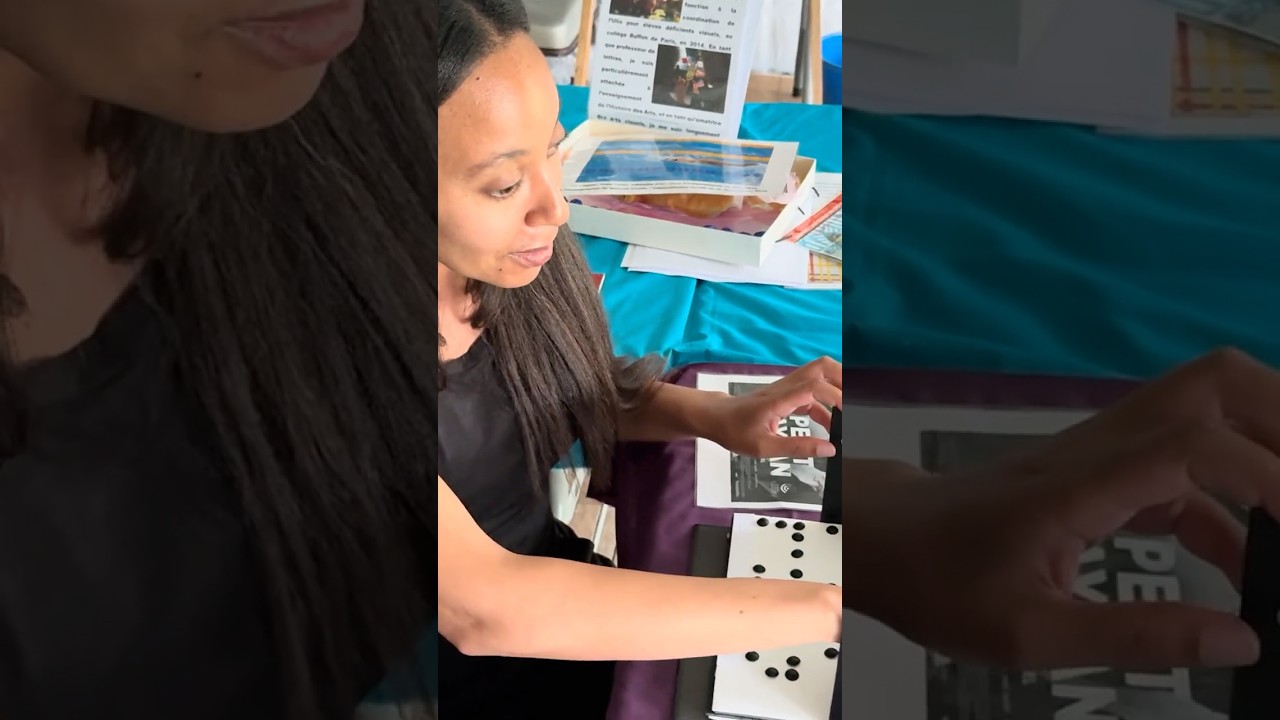
Haben: All art should be accessible, including movie posters. In movie posters, the text of the title of the movie is usually very big to catch people from a distance.
Movie Poster: Large white text near the bottom of the page says, "Petit Paysan," and under that in smaller text, “Un Film de Hubert Charuel.” Standing in the middle of the image is a man with his arms crossed, wearing an irritated expression. He appears trapped in the middle of a herd of black and white cows.
Haben: Well, to capture that same concept, we have jumbo Braille.
The camera then cuts to a close-up of her hands reading large Braille dots on a board attached to another diorama display. The jumbo Braille title is followed by text in regular sized Braille.
Haben: So a big part of that poster is the experience of the main character, a cowboy, in his kitchen surrounded by cows.
The video zooms in on a box full of sculptures of cows made of soft fabric, except for their sharp horns. In the middle stands a toy figure of a man with his arms crossed. All of the pieces are movable.
Haben: So we have physical representations in 3D of cows here in a box representing the picture, with a cowboy in the center.
The video briefly flashes an image of a raised line drawing of the Eiffel Tower before returning to Haben sitting beside the movie poster diorama.
Haben: Oftentimes tactile art is flat, and you miss a lot. But this type brings it alive.