France made me a Knight, and my mission is Braille!
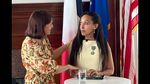
France made me a Knight, and I made France a promise. I may have a guide dog instead of a horse and a keyboard instead of a sword, but I pledge to champion Braille across the globe. Critics argue Braille doesn’t belong in our modern world, so in my acceptance speech I connect the dots. France’s celebration of Braille gives me hope that others will do the same.
Join me in calling on every community to advocate for Braille.
Jump to heading#Descriptive Transcript
The video begins with French Consul General Valérie Brisset pinning the insignia of the Knight of the Order of Arts and Letters onto Haben Girma’s dress. Haben wears a light-colored sleeveless dress with a textured fabric that catches the light with a soft shimmer. Her fingers read from a Braille computer on a table. Valérie wears a flowing dress with a floral pattern. Behind them, part of the French flag is visible above the room’s wood paneling and stone fireplace.
Valérie: Haben, je vous fais chevalière des Arts et des Lettres. Congratulations, Haben!
Photo: Close-up of the insignia: an eight-petal green enamel flower outlined in polished silver, suspended from a green ribbon with two white stripes. At the center, the words “République Française” encircle a white medallion bearing a gold monogram of the gracefully looping letters A and L. The video returns to Valérie shaking hands with Haben.
Haben: Merci!
(Laughter and Applause)
Valérie: Bravo à vous, je suis!
Haben: Thank you, this is a huge honor!
She turns to the audience.
Haben: My name is Haben Girma and I have three disabilities: I can’t see, I can’t hear, and I can’t speak French.
(Laughter)
Haben: The fact that France is giving me this honor shows how deeply Braille is treasured there. Braille was invented in France, and Louis Braille, when he was a teenager, developed this tactile reading system. It became global. Now we have Braille in Tigrinya, Korean, and almost every language has Braille.
In the United States, support for Braille is decreasing. Critics say it’s over 200 years old. It’s ancient technology—dump it. They don’t say that about 200-year-old French wine.
(Laughter)
Valérie: You’re right!
Haben: 200 years is young for a writing system. Ink has been around for thousands of years. Sighted people still write with ink!
And another argument critics have of Braille is they say today we have audio technology and audiobooks. But not everyone can hear. And second, we’re not just consumers, we’re also creators. I think a lot of people in the publishing world still don’t know about Braille and we have to educate them.
When I was working on my book, we sent the manuscript to the publisher’s audiobook department. And they sent me an excited email saying: We will find you a voice actor to play your voice. And I thought, what about my voice?
(Laughter)
Haben: So I found myself in this strange position of having to campaign for my own voice to represent me. And I told them: I can read, I can speak, I even know the woman in the book.
(Laughter)
Haben: They agreed to let me try, and I read the manuscript in Braille out loud. They liked it, and they decided afterwards that blind people can create audiobooks.
Braille is not just for reading, it’s also for authorship—whether you’re creating books or code and doing computer programming. Braille is powerful even today. The problem is that sighted people underestimate blind people, and this has been going on for a long time.
During World War II, when Germany invaded France, there was a brave blind student who asked himself, “What can I do to end the violence?” And he was worried because people on the street just saw him as a blind guy. But he realized that was his asset. He could turn the underestimation of his abilities into his power. It became a kind of invisibility cloak. And he was able to organize one of the largest youth resistance groups in France during World War II.
It was very powerful, and Jacques Lusseyran is celebrated as a resistance hero in France. He did this for almost two years. And then the Germans got suspicious, and some soldiers searched his room. They found thousands of papers, but they couldn’t read them.
(Laughter)
Haben: They were in Braille. After the war, Jacques moved to the US and he became a professor, and Braille continued to serve him.
From the very beginning, Braille has been about freedom. The freedom to shape our words, our voice, our future.
Today’s AI technology is undervaluing disabled wisdom. If I take a picture of a page of print with ChatGPT, ChatGPT can read it. If I take a picture of a page of Braille, ChatGPT will fail. That’s outrageous! This is not an engineering problem, this is a priorities problem.
When we’re building technologies, schools, libraries, and other institutions, advocate for accessibility, including Braille. I am so grateful to France for giving the world Braille, and for celebrating Braille’s continuing power. Thank you.
(Applause)
Valérie: Thank you, Haben. Thank you so much.