How do blind people sign their names? Two blind authors sign in two different ways.
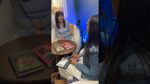
When one story rules them all, the rest of us become invisible. So let’s lift up more disabled authors. Here are two: Molly Burke, author of Unseen, and me, author of Haben. We signed books for each other before recording an episode of What It’s Really Like.
Jump to heading#Descriptive Transcript
Molly Burke and Haben Girma sit chatting in Molly’s podcast studio.
Haben: People were always comparing me to Helen Keller, and I wanted to be my own person.
Molly: Exactly! The more books the better, the more representation the better. Because no one person can represent such a diverse community.
As Molly speaks, an interpreter off-screen types her words, and Haben reads them through her fingers on the Braille display in her lap.
Haben: You probably know her as the blind woman, but I know her as an entrepreneur who’s built up an empire living her dreams.
She glides her fingers across the book cover, reading the Braille out loud.
Haben: Unseen by Molly Burke.
The subtitle says, “How I Lost My Vision but Found My Voice.” The cover has a green background with bold, golden text and a portrait of Molly with her hands against her cheeks. A slash of light rakes across her right eye.
Haben: I’ve read this book twice, digitally with electronic Braille. I have the print copy because I like having physical things, and it also is going to impress a lot of my sighted friends.
Molly laughs.
Haben: So Molly, can you do me the honor of signing a copy of your book?
Molly: I would love to! That was one of the sweetest introductions anyone’s ever given me. And I’m… it’s so kind to hear that you read it twice. That makes me so happy.
As she speaks, she opens the book on the table in front of her. Her right hand anchors the page while her left, using an orange marker, writes her name in flowing, easy-to-read cursive, followed by a smiley face.
Molly: I worked really hard to make sure that we could get a version in Braille for the NLS. So… I’m really happy to hear that that made it more accessible for you to read. And I obviously have to get you to sign a copy of your memoir.
Haben: I would love to!
She puts the print copy of her book on the table. The cover shows Haben in profile, confidently facing forward. The background is a warm red, and white text over the bottom half of the image says, “Haben: The Deafblind Woman Who Conquered Harvard Law. Haben Girma.”
Molly: Yay! And then there’s the sticker that says Haben!
Haben searches the table, finding the marker and feeling the book covers.
Haben: That’s your book, and here’s my book. And I can confirm it’s my book because it says Haben in Braille!
Molly: Neither of us can read anything else about the books, but we can both read the Braille on the covers!
Haben anchors the book with her left hand while her right, using the same orange marker, writes “Haben” with a large, looping flourish.
Haben: Signed!
Molly: The sound of your writing sounded so much like more slow and intentional than mine, which leads me to believe yours is more legible than mine maybe. I feel like I like quickly scribble it out and it sounded like you took like such time and care with yours.
Haben: I know if I slow down and am intentional with every pen stroke I increase the chances of people, of sighted people, being able to read it. But even if they can’t, they will be honored to get a squiggle from me.
Molly: They know it’s a Haben Girma squiggle. The icon herself!
Haben: (Laughing) Thank you, Molly.